Accounts for dental practice owners Dental Accounting
Automating Dental Associate Pay with AI
Automate dental associate pay in your UK practice. Replace manual spreadsheets with Samera AI to sync Dentally and Xero, eliminate errors, and cut admin time from hours to minutes.
Manual associate pay takes 3-5 hours per practice per month – and up to 15 days for larger groups.
The most common errors are lab invoices going to the wrong associate and incorrect percentage calculations.
Samera AI connects directly to Dentally and Xero – your deduction rules go in once and the calculation runs itself.
Your finance team still reviews and approves the output, it just takes 30 minutes instead of hours.
Associates who can see how their pay was calculated raise fewer queries and are less likely to lose trust in the practice.
Three to five hours. Every month. Just to figure out what your associates are owed.
If that sounds familiar, the spreadsheet, the PMS export, the lab invoices spread across your desk, the formula you are terrified to touch, then you already know why automating dental associate pay is not a nice-to-have. For most UK practices, it is embarrassingly overdue.
This article covers why the manual process exists in the first place, what it is actually costing you beyond the hours, how AI associate pay automation works in practice, and what to look for when you are ready to do something about it.
Why Dental Associate Pay has Always Been Calculated Manually
Ask anyone who has done it, dental associate pay is nothing like running a standard payroll. With a salaried employee, the number is fixed. The payroll system knows it, applies it, done.
Associate pay is a different animal entirely, it moves every month, it is built on production or collections figures, and it gets adjusted by a set of deductions that vary not just between practices but sometimes between individual contracts within the same practice.
And the data you need to build that calculation? It is scattered across at least four different places. Production figures live in the practice management system. Payments and collections live in the accounting software. Lab invoices land from external suppliers and need to be manually matched to the right associate. Card processing fees sit in a separate terminal report. None of these talk to each other. You pull them all, line them up, and start reconciling, by hand, every time.
Then there is the deduction logic, which is where things get really practice-specific. A private practice might split lab fees 50/50 with the associate. An NHS practice has UDA targets baked into the calculation that directly affect what the associate takes home. A mixed practice is dealing with both simultaneously. Some contracts have an overhead contribution on top. Some do not. There is no standard formula that works everywhere, there is just yours, rebuilt from scratch each month.
“The reason there hasn’t been a proper software solution for associate pay until now is that the data for all of this sits in different systems. Lab bills sit in one system, clinical treatment data sits in another, and never the two are sitting together. Our job has been to bring all of that data into one integrated platform and then do the associate pay from there.”
Arun Mehra Samera CEO
The spreadsheet filled the gap because nothing better existed. It was free, it was flexible, and for a single-associate practice it more or less did the job. But it was never built for this. One associate – manageable. Five – you are one bad formula away from a problem. Multiple sites – it stops being a spreadsheet and starts being a liability.
Trupti Darekar, Client Accountant at Samera, works through these calculations with dental practices every month. She sees the same mistakes repeatedly.
“The major errors we see are wrong lab bills going to the wrong dentist, and wrong calculations of the percentage. Those two things come up again and again with clients.”
Trupti Darekar Samera Client Accountant
Both come from the same place, a process held together manually that was never designed to be manual. A lab invoice tagged to the wrong associate quietly reduces one person’s pay and inflates another’s. A percentage that has shifted in the spreadsheet, by a decimal, by an accidental keystroke runs uncorrected for months until someone notices the numbers do not feel right.
What Manual Associate Pay is Costing Your Dental Practice
Most practice owners think of associate pay as a time problem. It is that but the hours are honestly the least of it. The costs that do not show up on a profit and loss are the ones that hurt more- the associate who quietly stops trusting you, the dispute that escalates before anyone realises how it started, the practice manager who spends every month end doing financial admin instead of actually managing the practice.
Start with the time. Samera’s benchmark for a typical single-site UK dental practice is four to five hours per month on manual associate pay calculations. For groups, that number does not scale linearly, it explodes.
“I was speaking to a group last week with about 40 practices, and they told me it takes them between 10 and 15 days just to get associate pay done and they consider themselves quite organised. Information is coming from different locations, lab bills from another, everything sitting in different pots. It’s just not organised.”
Arun Mehra Samera CEO
Ten to fifteen days. Per month. For a task that should take minutes. And that is at a well-run group. The time your practice manager spends rebuilding that spreadsheet is time they are not spending on patient relationships, team development, or anything else that actually moves the practice forward.
The error cost is harder to put a number on and considerably more damaging. An underpaid associate loses trust immediately. An overpaid one has to be asked to hand money back, which is uncomfortable at best. Let it run for a few months without anyone noticing and you are no longer having an awkward conversation, you are potentially having a legal one.
“We have seen cases with clients where associates haven’t been paid correctly for months. By the time lawyers get involved, it is messy, expensive, and just draining mentally for everyone. And often it started with a spreadsheet error that nobody caught.”
Arun Mehra Samera CEO
Good dental associates are not easy to find and not easy to keep. They talk to each other, they compare notes, and a practice with a reputation for pay errors even an informal one, passed around at study clubs will feel that in recruitment and retention long before it shows up anywhere official.
“If pay is continually calculated wrong, people stop trusting the practice owner. That has a knock-on effect on motivation, and then people decide they don’t want to stay. If you have a system that’s transparent, where the associate can see exactly how things have been calculated that only helps the situation.”
Arun Mehra Samera CEO
Pay is personal. Getting it wrong once is a mistake. Getting it wrong repeatedly is a statement about how your practice operates and most associates will reach that conclusion long before they say anything out loud.
How AI Automates Dental Associate Pay: A Step-by-Step Guide
Let’s be clear about what automation actually means here because “AI” gets thrown around a lot and it is worth being specific. When it comes to automating associate pay, AI is doing something specific. It means replacing the parts of the process that eat your time and introduce errors, the exports, the cross-referencing, the formula-wrangling with a system that handles all of that in the background. Your finance team still signs off. They just stop building from scratch every month.
Before anything runs, Samera AI pulls two years of historical data from both Dentally and Xero and checks it properly. This is not a glamorous step, but it is arguably the most important one. No two practices use these systems in exactly the same way, so the platform needs to confirm the data is clean, consistent, and actually usable before it starts making calculations with it.
“Everyone uses Dentally differently, everyone uses Xero differently. So we want to pull two years of historical data from both systems first, check the integrity, make sure it’s clean and usable. Once we’ve done that, we can then do the associate pay month by month and know that the data we’re working with is reliable.”
Arun Mehra Samera CEO
Step 1: Connect your practice management system
Dentally connects directly to Samera AI via a live integration. Production data, broken down by associate and by period comes through automatically. No exports, no transfers, no copying anything anywhere.
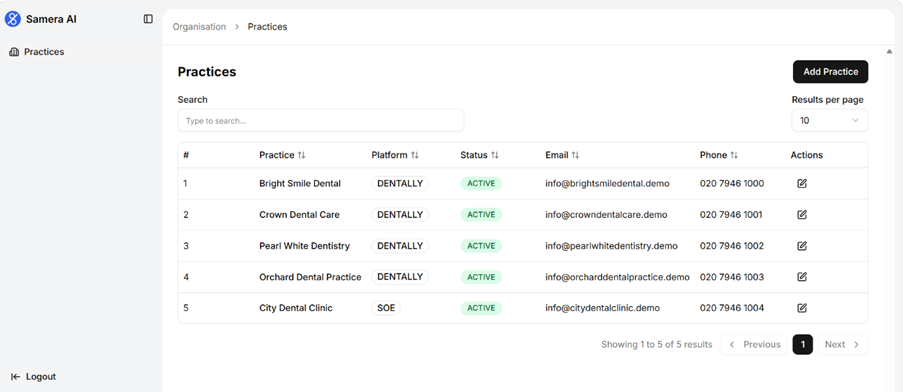
Samera AI connects your practices directly. Each site shows its platform connection status and can be managed from a single view.
Step 2: Connect Xero
Same process for the accounting side. Collections data and payment information sync automatically, so the platform always has a current picture of what has been billed and what has actually landed.
Step 3: Configure your deduction logic, once
This is where your practice’s specific rules get built in. Lab fee splits, card processing deductions, NHS UDA adjustment rules, any overhead contributions in your associate contracts, it all goes in once. After that, the system applies it every month without anyone touching it. No re-entering, no re-checking, no “wait, which version of the spreadsheet has the right percentages?”
Step 4: Month-end calculation runs automatically
At month end, the platform calculates dental associate pay using the data it has already pulled and the rules it already knows. There is no formula to maintain, no reconciliation to run manually, no opening last month’s file and hoping nothing has drifted.
Step 5: Your team reviews and approves
A consolidated report lands for each associate, production, collections, every deduction itemised, net pay. Your finance team’s job is to review it and approve, or query a specific line if something looks off. A process that used to take four or five hours typically takes under 30 minutes at this stage.
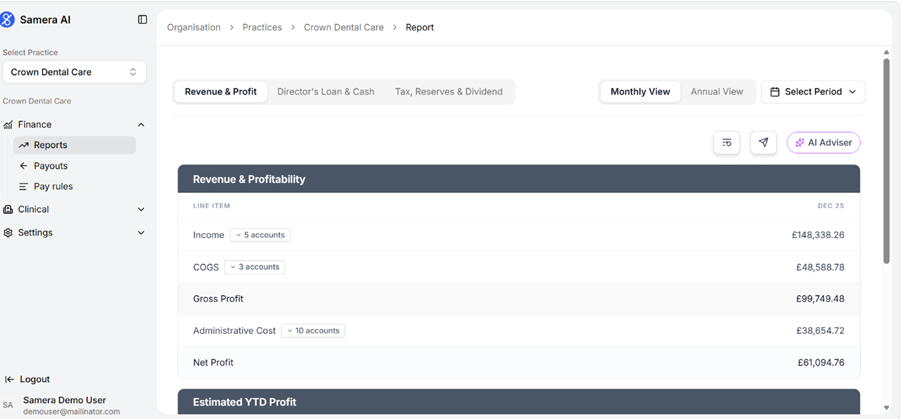
The report your finance team reviews each month. Income, costs, gross profit, and net profit broken out by period. Select any line to drill down to the underlying transactions.
Pay slips go directly to associates from within the platform, with every line item visible. They can see exactly how their number was reached, which production figure, which deductions, what the net represents. That transparency on its own cuts down associate queries significantly, and those queries are a time cost most practices never think to measure.
“For us, associate pay is literally the first one per cent of where we’re going with Samera AI. Whilst we’re solving this problem, it opens up a whole range of other data that helps us understand the business better and provide further insight and advice to our clients on top of it.”
Arun Mehra Samera CEO
Manual vs Automated Dental Associate Pay: A Side-by-Side Comparison
The table below maps the manual process against the automated one, stage by stage. If you are still running dental associate pay on a spreadsheet, read each row and be honest with yourself about which column you are living in and what it is costing you to stay there.
Area
Manual (spreadsheet)
Automated (Samera AI)
Gathering data
Hours of CSV exports from your PMS and accounting software manually stitched together each month
Instant, automatic sync from Dentally and Xero, no exports, no copy-paste, no manual transfers
Calculations
Fragile spreadsheet formulas, one wrong cell cascades silently across every associate’s pay
Logic configured once, applied identically every month, no formula maintenance required
Lab fee deductions
Cross-checked by hand against paper or emailed invoices, easy to misallocate or miss entirely
Auto-reconciled against pre-set deduction rules, allocated to the correct associate every time
Accuracy
High error risk particularly when last month’s file is used as a template without full review
Consistent and fully auditable, every figure is traceable to its source data
Associate transparency
Hard to explain to associates when queried, ‘the spreadsheet says so’ is not a satisfying answer
Every line item is visible and traceable, associates can see exactly how their pay was calculated
Scalability
Time and error risk multiply with every new associate or additional site
The same logic handles 50 sites as easily as one, no rebuild required as the group grows
Month-end time
3–5 hours per practice, every month, more for groups with multiple sites
The finance team reviews and approves a completed report, typically under 30 minutes
Dispute resolution
Tracing errors requires going back through spreadsheet versions, time-consuming and often inconclusive
Every calculation is logged and auditable, disputes are resolved in minutes, not days
Look at the dispute resolution row. That one tells you everything. When something goes wrong in a manual process, you are not just fixing a number you are going back through multiple versions of a spreadsheet, trying to reconstruct a calculation that was built at month end when everyone was under pressure and nobody was being as careful as they should have been.
It can take days. With an automated system, every figure is logged from the moment it enters the platform. You can trace any number back to its source in minutes, not days. That is not a minor convenience, for a practice that has ever had an associate dispute a pay figure, it is transformative.
“What makes the AI software superior is speed. They don’t actually have to do anything – it just does it. Assuming everything has been set up correctly and the bookkeeping is in order, the time saving is instant. Speed and accuracy. Those are the two things people notice first.”
Trupti Darekar Samera Client Accountant
Choosing Dental Associate Pay Software: What to Look For
Dental associate pay software is a young category, which means the market is still a bit of a mixed bag. Some tools that call themselves automation still need you to export a file manually and upload it at which point all they are doing is applying a formula to data you have already pulled yourself. That is a neater spreadsheet with a nicer interface. It is not automation. Here is what to actually look for.
Does the provider understand dental practice?
This is the question that matters most, and it should come before any conversation about features or pricing. General payroll software – Sage, Xero Payroll is built for employees on fixed salaries. It has no concept of production-based pay, no understanding of lab fee deduction structures, no awareness of NHS UDA targets or how they affect what an associate actually takes home. “Dental-specific” should mean built from the ground up around how UK associates are paid not a generic tool with a dental logo on the login page.
“The most important question to ask any provider is: do the people who developed this actually know how dental practices work? Do they understand the problems practices face day by day, week by week? The key is to solve real problems not just provide fancy dashboards.”
Arun Mehra Samera CEO
Is the integration genuine?
If getting your data into the platform requires you to export a CSV from your PMS and upload it manually, the fundamental problem has not been solved it has just been moved one step along. What you need is a direct, live connection between the platform and both your practice management system and your accounting software. That is the difference between actual dental associate pay automation and a slightly more organised version of what you are already doing.
Can it handle your deduction logic specifically?
This is where a lot of platforms fall short. NHS UDA calculations, private fee splits, lab fee arrangements, card processing deductions none of these are standard. They vary between practices, and often between individual contracts within the same practice. Do not let any provider show you a generic demo and assume it covers your setup. Ask them to walk through your actual rules. If the answer involves manual workarounds, keep looking.
Will it still work when you grow?
A platform that handles three associates at one site reasonably well is not necessarily going to cope with fifteen associates across four sites without your finance team having to rebuild the configuration from scratch each time. If growth is on the cards even loosely make sure the system was designed for it. The efficiency gains from automating dental associate pay compound as a group scales, but only if the infrastructure was built to scale with you.
What does the associate actually see?
This one gets overlooked more than it should. An associate who receives a clear, itemised pay summary every deduction explained, every figure traceable is an associate who raises fewer queries, trusts the process, and is less likely to quietly start wondering whether they are being paid correctly. A platform that produces a pay slip your associates can actually understand is not just good for relationships. It saves your practice manager time every single month.
How does it handle your data?
Associate pay means sensitive financial data. In practices connected to Dentally, it means data that sits close to patient records. Any third-party platform handling this needs to be GDPR-compliant and storing data on UK-based servers, not just claiming to be compliant in the small print. Ask directly, and if the answer is vague, that tells you something.
“When choosing any associate pay platform, make sure the provider has all the necessary credentials, that they’re GDPR compliant and that the data sits on servers based in the UK. That’s an important aspect from a cybersecurity and data protection point of view.”
Arun Mehra Samera CEO
One thing worth being clear about before we move on: Samera AI is not a payroll system. It does not deal with PAYE, employer National Insurance, or any of the tax obligations that come with employing staff, your existing payroll provider handles all of that. What Samera AI does, specifically, is calculate what each self-employed associate is owed each month. Accurately, consistently, and with a full audit trail so that if anyone ever questions a figure, the answer is already there.
Stop Calculating Dental Associate Pay Manually
Four hours a month. Every month. On a calculation that should take minutes.
If that is where you are, whether you are a single-site practice nursing a spreadsheet or a growing group where associate pay is eating days of your finance team’s time, it is not going to fix itself. The data is not going to start talking to each other on its own.
The formula is not going to stop breaking. The associates are not going to stop calling.
Samera AI is the UK’s first automated associate pay platform built specifically for dental practices and groups. It connects directly to Dentally and Xero, applies your deduction logic automatically, and produces a clear, itemised pay summary in minutes, for one associate or fifty.
How long does it take to automate dental associate pay with AI?
Less time than you probably think. The initial setup- connecting Dentally and Xero, building in your deduction logic, running the data audit takes a few hours with Samera AI support. After that, the monthly calculation runs on its own. Most practices go from spending four to five hours a month on this to spending twenty or thirty minutes reviewing a report that is already done.
Can AI handle different deduction rules for different associates?
Yes – and this is exactly where a dental-specific platform earns its place. Samera AI applies deduction logic on an associate-by-associate basis, so different lab fee splits, different NHS UDA adjustments, different overhead contributions, different percentage arrangements can all be configured separately. Set the rules once per associate and the system applies them consistently every month without anyone checking or re-entering them.
Is automated dental associate pay GDPR compliant?
It should be – but “should be” is not good enough when you are connecting a platform to your PMS and accounting software. With Samera AI, data is stored on UK-based servers and the platform is GDPR-compliant. Before signing up with any provider, ask them directly about data residency and security credentials. If the answer is vague or buried in a privacy policy, that is worth paying attention to.
What is the difference between associate pay software and payroll software?
They solve completely different problems. Payroll software like Sage or Xero Payroll is built for employees – people on fixed salaries, with employer tax obligations, National Insurance contributions, and PAYE attached. Dental associate pay software is built for self-employed associates whose pay changes every month based on what they produced, what was collected, and what deductions apply under their contract. Associates handle their own tax. The two categories are not interchangeable, and trying to use one to do the other’s job is where a lot of practices run into trouble.
Does Samera AI work for NHS practices as well as private?
Yes. NHS UDA-based deduction logic, private percentage splits, and mixed-practice arrangements can all be configured within the platform. UDA targets and NHS adjustment rules are built in on a practice-by-practice basis, so NHS associate pay runs through the same automated process as private – correctly calculated, every month.
At what point should a dental practice consider automating associate pay?
Honestly? The moment it starts feeling like a chore. For most practices that is somewhere around two or three associates, when the spreadsheet starts needing real maintenance and the margin for error starts feeling uncomfortable. If your finance team is spending more than an hour a month on this, or if you have had even one pay dispute or miscalculation, the case is already there. For groups with multiple sites, the question is not really whether to automate, it is why you have not done it yet.
Neha Jain is a skilled content writer with a rich background in business and financial knowledge. With a bachelor’s degree in English Literature and Psychology, Neha has honed her writing skills, furthering her expertise with the Content Writing Master Course (CWMC) at IIM SKILLS and a Content Marketing Certification from HubSpot Academy.
Working alongside our business development experts, Neha specialises in helping accountants, dentists and other healthcare professionals start, scale and sell their businesses.
Arun, founder and CEO of Samera, is an experienced accountant and dental practice owner. He specialises in accountancy, building businesses, financial directorship, squat practices and practice management.
Trupti is one of our accountants who works directly with dentists, dental practice owners and dental groups of all sizes across the UK. She specialises in helping dentists with managing bookkeeping and preparing monthly management accounts.
Need help with your dental accounts?
Samera works with dental associates, practice owners and dental groups to manage accounts, tax, bookkeeping and financial reporting. If you want clearer numbers, less admin and a system that works throughout the year, book a free consultation with our dental accounting team.
Contact us to talk directly or find out more about our accountancy services:
By booking you agree to our privacy policy. We’ll never share your details.
We use cookies
We use cookies to make the site work, and — only if you say it's OK — to measure
how it's used and improve it. You can change your mind any time from the
Cookie Policy.
Essential
Required for the site to work — page navigation, booking modal, contact forms, basic preferences. Always on.